I was fortunate enough to attend a psychedelics seminar that presented the results of the first ever fMRI study that investigated what happens to the human brain on LSD. Read on to explore the science, my theories and as always the anthropological experience.
The conference
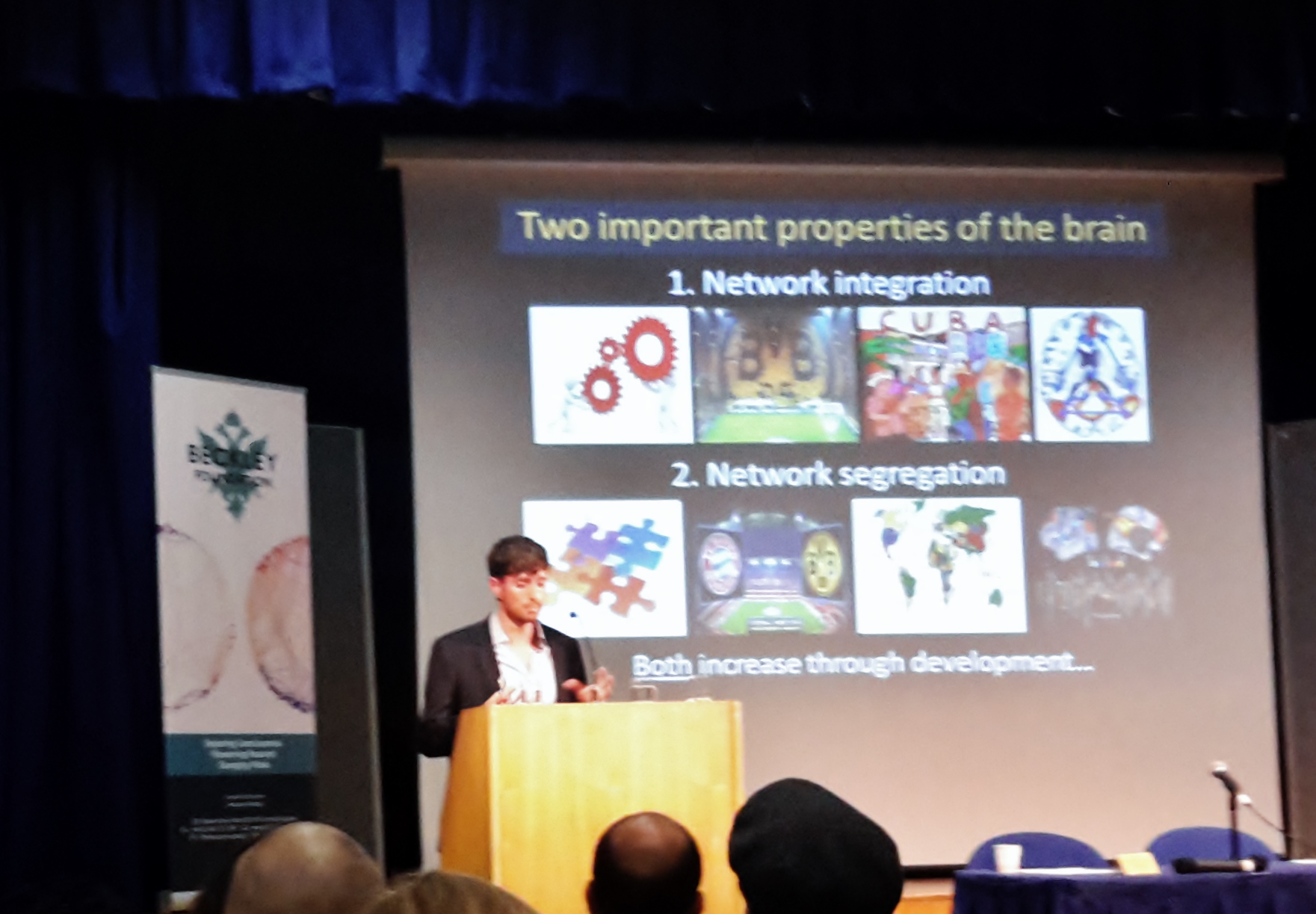
This was not a typical scientific seminar, there were almost no ‘professionals’ attending yet the conference hall was packed with around 150 people that were really excited, which is a rare case for university seminars. These people actually paid to support the study in what is possibly the largest crowd funding scientific experiment to date (the money side was head by WALACEA a site trying to democratize science).

The ‘Self’ network trying to predict the ‘meme’ machine we are made of.
I arrived early and used the time to conduct an informal survey. Most of the people were there because psychedelics had helped them or loved ones. Many of them had been following the media divulging very positive results regarding psychedelics experimental treatment for anything from alcoholism to the fear of death in those terminally ill. ‘My dad had terminal cancer and from what I read I wish he had access to psychedelic treatment’, one women told me and I found myself sharing with her and others my limited knowledge.
Psychedelics will reveal the scaffolding ‘you’ are really made of. The various networks that are creating a meme machine that is constantly connecting “cause” and “effect”, trying to predict the sensory inputs, will be exposed. These networks know nothing about permanence, they are in constant change being turned on and off according to environmental influence. It is only the higher level “self “ that has created an inaccurate model of permanence. This ‘self’ is just a network that links the other networks together trying to predict (and thus influence) the behavior of the whole organism, as well as other organisms (if you are interested you can read more in my neuro-philosophy paper). Once this specific network is destabilized and reality is experienced without it, a familiar sensation takes over, we have all felt it as young children before we had a “self” and if we are perceptive enough we get a slight glimpse of it every night for a brief moment before we fall asleep. If experienced in the right environment there is only wonder and openness in this state of being.
Some Background
Amanda fielding from the Beckley foundation for consciousness and drug policy research, which has been supporting this research, told a tale from her personal history. When psychedelics were still legal, they had a massive impact on her life, and she began working on the connection between consciousness states and blood flow to the brain way before fMRI was everywhere.
Prof David Nut, used his exquisite British wit and love of Aldous Huxley to delved into the idiocy of policy makers when it comes to drug research. “Orthodoxy is the diehard of the world of thought. It learns not, neither can it forget.” – he quoted Huxley hoping that after 50 years of spewing blatant lies policy makers will start looking at the science that shows the massive positive impact psychedelics can have and indeed have had on most pre-Christian cultures.
The results in a nutshell
With great clarity and a tad of British shyness Dr Robin Carhart-Harris presented his experiment and preliminary results to the mostly no- scientific crowd. 20 healthy subject with previous experience with psychedelics (16 m 4 f) received 75 mcg of lsd intravenously (which gives a stronger affect that digesting it. This was chosen because of the extremely expensive price of 3000 pounds! for a dose of ‘legal’ LSD from a lab in Switzerland). They were scanned in an fMRI machine while resting and then also listened to music in an experiment designed by Mendel Kaelen.

The ‘normal’ brain on the left (few controlled high ways) and the brain on Psilocybin (many new roads open), a graphics based on fMRI functional connectivity data.
I’m going to start with a metaphor that wasn’t used and is a little wider than what can totally be proven but I’ll show some evidence to support it and suggest some more experiments that can be done to test it so bear with me. Imagine your brain is a city with many neighborhoods each of them with its distinctive characteristic and function in the city. There is the stressed financial district dealing with money, soho with its art and hipsters, the industrial area with all the factories and down town with its restaurants. In order for the city to function these different areas have to communicate with each other and pass information and goods between them. To do that, imagine these neighborhoods were connected by highways but not everyone could get on these high ways. There were tolls and these highways were highly regulated by a central government that decided what has to go where. Then, imagine one day the toll company went on strike and these highways were closed down. What would happen?
At first each neighborhood would be less influenced and constrained by the others and could have more freedom in managing its activity. But for the city to still keep running some information would need to be shared and collaborated so the back roads would start getting used and new roads would start to be built, these roads wouldn’t be as regulated at the high ways so some soho artists could go to the financial district and start painting the buildings even if they weren’t asked to while some accountants and lawyers could go downtown to have a good time.
 In this metaphor the people are the electrical brain activity, the neighbourhoods are the specialized networks that deal with specific types of information and the. The 5ht2a serotonin receptors in your brain sit at critical nodes constricting information flow, performing the function of a “Toll”. Lsd and psilocybin over stimulate these receptors and the ‘toll company’ goes on strike.
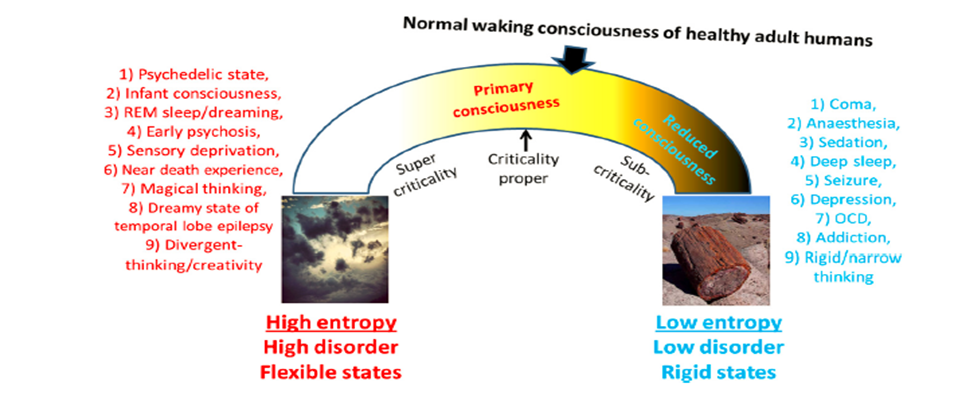
Carhart-Harris uses the term The Entropic Brain Hypothesis to outline his theory that claims that the brain in in a high entropic state with a higher disorder and more flexibility while on psychedelics.
How is this seen in brain imaging?
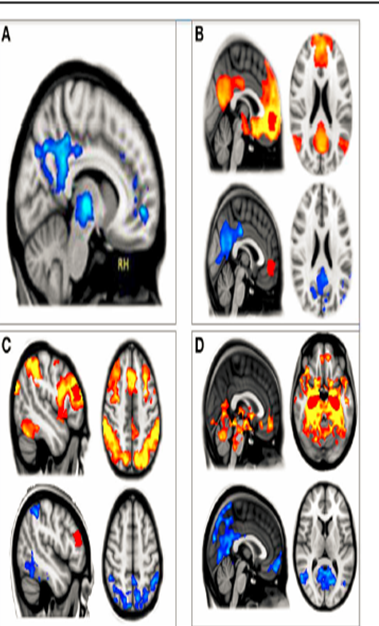
Passive eyes closed resting state fMRI scan
Psilocybin decreases BOLD signals in DFM and decouples them. Similar results found for LSD.
(R. L. Carhart-Harris et al., 2012; 2013)
It turns out that this ‘toll company’ is actually responsible for a lot of the brain activity, and the main results seen in fMRI for both LSD and psilocybin is less blood flow in these critical areas of the brain. Especially in the Default Mode Network that deals with ‘self-memories’ and according to Carhart fits well with Fraud’s notion of ego (and my idea of a self being a model that predicts the organism’s behavior)

MEG data showing decrease in brain wave activity (Muthukumaraswamy et al., 2013)
Now when you look at what’s left of the blood flow you see that the correlations between areas grow representing this higher degree of connectivity and when looking as close by areas the blood flow becomes less homogeneous.
MEG results for LSD weren’t presented yet, but a previous paper (Muthukumaraswamy et al., 2013) showed that decrease in activity of brain waves each, bandwidth decreasing in a different area.
One surprising result in which LSD was different from psilocybin was that LSD increased blood flow to the visual areas while psilocybin didn’t. Carhart postulated that this might be because of the different time line of the drugs, the psilocybin when administered intravenously takes affect very fast while LSD doesn’t and the timing of the scan might show a specific phase of the drug. I would be very interested in getting the exact details of the experiment and comparing them, to see if there were any other changes in the experiment design that could explain this, some environmental influence that would activate the visual area in the LSD experiment more than it did in the psilocybin one.
Predictive Coding and my dream thesis
If you’ve been following my latest blog post you’ve already heard of predictive coding. The predictive coding framework claims that in essence the brain is a prediction machine, it tries to predict it’s sensory input to form a model of the environment (including itself). Predictive coding explains that the cognitive system is ordered hierarchically, in levels (Bastos et al., 2012). For any pair of levels, the higher-level will have hypotheses predicting the bottom–up signals from lower-levels. If the predictions are good, the bottom–up signals will be ‘explained away’. Only discrepancies between the winning prediction and the bottom–up signal remain as ‘prediction error’. This framework explains that sensory information is processed probabilistically, with prior predictions and posterior inferences made based on Bayesian optimized probabilities.
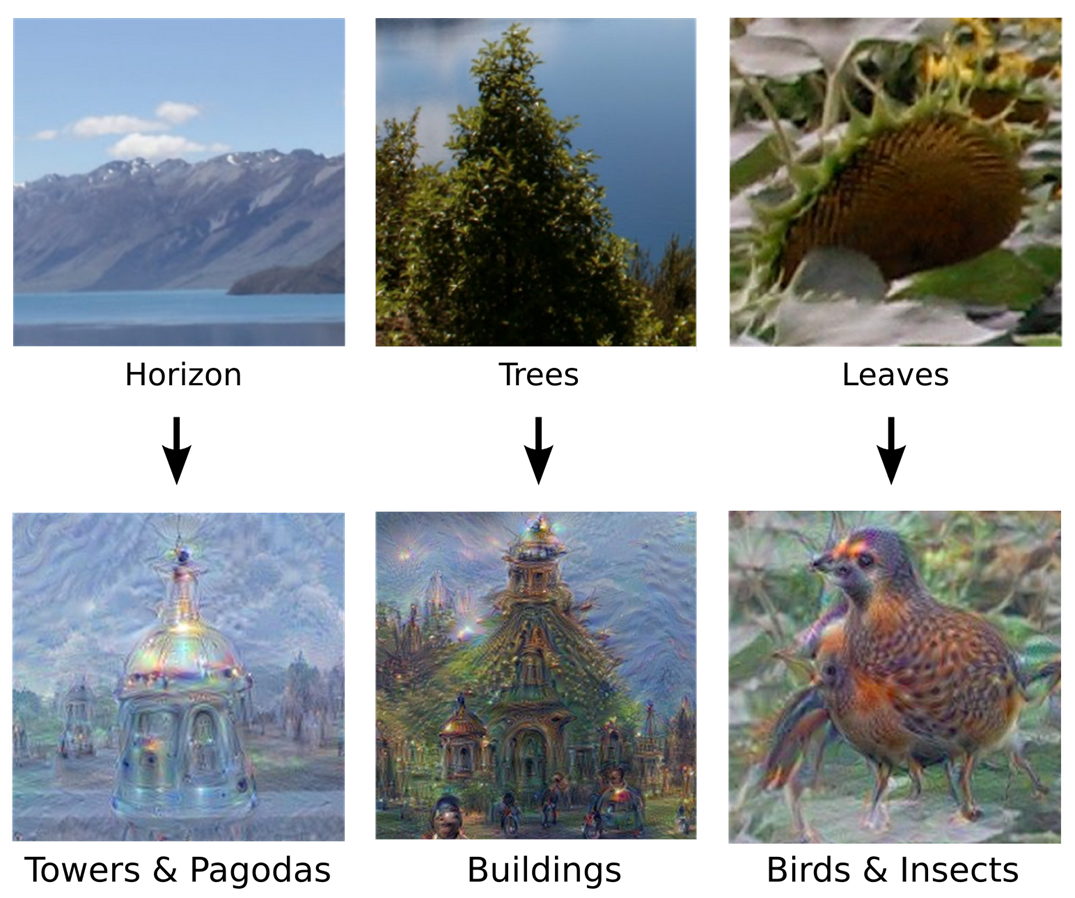
Google deep dream.
10-30 stacked layers of artificial neurons. Allowing a layer to become over active will produce “hallucinations”.
Since psychedelics seem to change the flow of information represented in the brain this framework can be a great model to help explain what is actually going on. Within the predictive coding framework I would postulate that Priors coming from the Default Mode Network aren’t passed to other networks and become less important in explaining away the bottom up sensory information. This will cause an increase in prediction error in lower levels of the brain. To deal with this, these lower levels will have to update their model more frequently without the constraint from higher layer priors. This can explain the visual hallucinations and the subjective experience of heightened senses, more vivid colours, sounds, taste and touch. The tree is perceived as greener because higher layer abstract prediction saying ‘yeah, it’s green, we’ve seen this a million times’ can’t reach the lower layer and turn off the incoming data. Furthermore subjective reports claim that hallucinations start out as just variations of a noisy signal, like clouds shifting and morphing, but after a few second of maintaining the same visual input a very vivid totally unrelated image might appear. This can be explained by accumulation of “prediction error” that finally makes it’s way through some back road and connect with some higher level network which suddenly explains away the prediction error with wrong higher level priors. This can also explain “trippy repetitive thoughts” because higher layer abstract networks can also be triggered in certain cases and hyper activated.
In other words Prediction error that gets into a network will be ‘overly explained” within that network which is released from it’s normal constrains This is exactly what is seen in Google deep dreams artificial neuron network. Neural networks trained to discriminate between different images can generate images too by inverting them (Mahendran & Vedaldi, 2014) and letting a layer enhance what it has ‘found’ causes very trippy images to be produced. Indeed, Cartheit mentioned that he believes something very similar is happening to the brain on psychedelics.
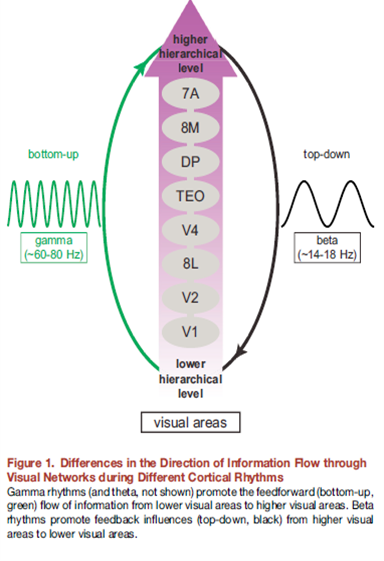
Forward vs backwards connections –
Granger causality
(Zheng & Colgin, 2015)
Psychedelic Treatments
Psychedelic treatment for addictions and post trauma are getting amazing result (see ref at the end). My speculative theory is that traumatic memories or addictive behavior are usually stored in the ‘worst neighborhoods’ isolated from the rest of the brain activity but still have managed to get enough access to the “tolls” and send out their predictions to the rest of the brain, effecting the general mood and behavior. While on psychedelics other networks that are being activated have an opportunity to reach that bad neighborhood and renovate it, add some color, good food or financial maintenance. This does work both ways however which is why the right “set and setting are crucial” and why Psychedelics should be treated with the utter most respect and care. There are many reports out the of a bad trip having long term and even permanent results on people.
My dream thesis
Recent papers have found that slow brain waves (alpha and beta) correspond with top down activity and expectations the brain creates while gamma activity corresponds to bottom up activity. They did this by using MEG data and performing a Granger causality analysis that can assess what signal is more likely to cause the other signal. I believe that comparing this type of analysis on the brains of people that have ingested psychedelics will allow us to characterize the different flow of information and possibly prove this theory. Specifically I would expect to see a lower Ganger causality in the Alpha bands coming from higher levels of the hierarchy to lower levels showing the decreased effect of the higher level priors. While within lower close by areas I would expect to see higher Granger causality in the Alpha band (if MEG is accurate enough to source locate close enough areas). And perhaps it would even be possible to locate areas that have a higher Gamma band Granger causality than usual because prediction error has been rerouted through them.
Short Summary
Couldn’t resist being a fan and asked Carhart-Harris for a photo
The science of psychedelics is finally starting to develop after years of being blocked by political reasons. Understanding how these substances affect us has the potential not only to teach us about ourselves but also to help treat some of the 21st centuries biggest problems. We really shouldn’t let closed mindedness stop the progress of this field, so how about sharing these thoughts with some friends or colleague?
___________
Psilocybin showing success in treatment of addictions and OCD: