Floating in the void

For ages now I’ve been itching to try a sensory deprivation tanל. This Easter I finally got the chance and it was an experience very hard to put into word. That doesn’t mean I won’t try, read on for more.
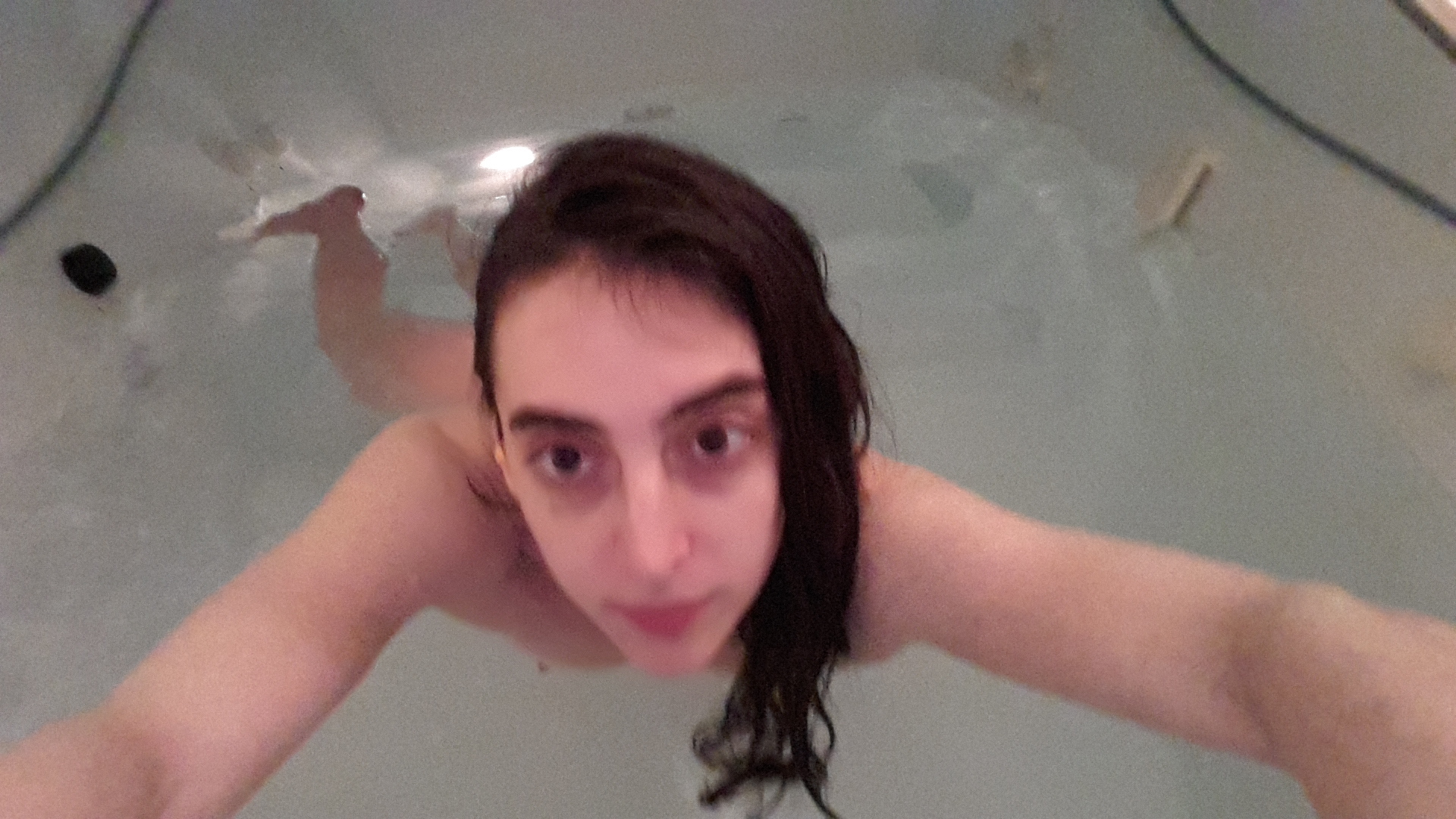
Just before closing the tank and turning off the light.

Just before closing the tank and turning off the light.

Sensory deprivation tanks have been around since the 50’s, a body temperature salt water bath that is enclosed in a totally dark booth with sound isolation. Why would someone want to try such a thing? Well these tanks were first used in experimentation trying to test the hypothesis that if all senses were cut off the brain would go to sleep. Long story short, people do not fall asleep in isolation tanks but their brain does have stronger slow theta waves seen normally right before sleeping, in meditation states and in children.     People also reported many different altered states of consciousness, hallucinations and claim that after the tank their senses were hyper strong and clear.


My experience

Getting into a laying down position in the tank wasn’t as easy as I imagined, every little movement would cause me body to rotate and move. It felt like I was in space. When I found a good position and turned off the lights it felt like slowly falling into an endless abyss. Everywhere around me there was nothing.

After a few minutes I began ‘seeing’ some purple color and shapes but that too went away and I had to remind myself to blink because I forgot if my eyes were open or closed. The most phantom feeling was in my feet. Occasionally I ‘felt’ my feet were touching the ground and had to wiggle my toes to make sure that they weren’t. After a few more minutes I began hearing the hum of electric machinery and at some point I was wondering about a ruckus someone with high heels was making, stomping around, but then realised it was my own heart beat. Usually when I meditate a thousand thoughts will pop up, mostly worrying about the future, school, finances and relationships. This time there were almost no verbal thoughts. My brain was very much awake and mostly silent. When I sent a query looking for the usual ‘stream’ the only thing that came back was: “All is good now, the future will come when it does”

My whole life I’ve experienced some oversensitivity to sensory stimulus, mainly in the soma sensory (touch) system. I hated wearing socks as a kid, everything would constantly itch me and drive me crazy. In kindergarten I was obsessed with sifting the sand in the sand box so I could run my hands through it without feeling all of these annoying bits and pieces. Whenever I would try to meditate in my martial arts training my senses would start ‘screaming’ and become overly irritated. I was hoping that this deprivation tank will help answer which part of my brain is causing the trouble.

Sensory deprivation tanks do not cut off your sensory input but they ‘feed’ the sensory receptors with information that has very little variance. In general, variance and change is exactly what your brain models. For those of you who have been following my posts, you should know by now that the brain is a hierarchical system with each layer explaining away and turning off the information from lower layers. Only the information that hasn’t been predicted progresses up the brain hierarchy in the form of ‘prediction errors’. So, once a stimulus stops changing our predictive mechanism easily explains it away and there is no information to communicate to higher brain areas. This will happen even with eyesight. Your eyes constantly make tiny micro movements to change the inputs of information. Without these movements, if you keep your eyes still you will go blind after a few moments, you can try this yourself.

My theory was the if the over sensitivity in my brain was due to increases top down prediction versus bottom up information, putting me in an isolation tank wouldn’t help and these prediction would enforce themselves on my perception anyway, perhaps even more so. But if my over sensitivity was due to increased precision of bottom up prediction errors steaming from my lower sensory areas than an isolation tank will decrease my symptoms. My top down predictions in these lower brain areas would finally be able to catch up and predict the over simplified sensory stimulus.

After a marvelous peaceful hour in the tank I have very little doubt that the second theory is much more likely.  I would postulate that ‘normally’ these overly precise prediction errors drive sensory input to higher areas in my brain than most people leading to a bunch of interesting symptoms and compensatory mechanisms.

Back to the real world

The lights faded in slowly yet still caught me by surprise. I climbed out of the tank and gravity immediately hit me. I wobbled around trying to get my ‘land’ legs back. In the shower, rinsing off the salt, the stream felt like a thousand little needles hitting my skin and I jumped up startled. I took my time in the waiting room, drinking some tea and trying to prepare myself for the outside world. The ‘noise’ came back again once I hit the streets.There was a sense of ‘self pity’, but instead of giving in to that I tried to top down ‘instruct’ this brain: “Try to get to those previous quiet states now that you know they exist.  I don’t know how plastic this brain is but I do believe that exposing it to this quiet state might allow it learn how to reach this state even in noisier environments.

When people ask me why I do all the strange things that I do I usually answer “because I can’t just sit down and stare at the wall in peace”. This experience has taught me that maybe I can. The wall just has to be total darkness and I have to be floating in a bath of salt water.

Finally, this has made me realize the possible benefits both in research and in therapeutic mechanisms floating can have and I will definitely be back for more. Next time I just have to remember to take out all the salt out of my ears because that’s driving me crazy now.



Seeing Is Believing

A friend’s visit took me to a museum exhibition that allows you to experience blindness for an hour. You navigate different locations in total blackness with only the voice of your visually impaired guide calling out to you.  Read on for some thoughts and insights about our brain.

download (1)

Ever since reading the philosophy of David Hume this realization that “I” am my sensory input has stuck with me. A year into my neuro science masters I’ll tell you that “I” am also these top down predictions that have been learnt throughout the years, but these predictions have been created in order to deal with sensory input. So what are blind people’s predictions? How do they experience the world without such a strong sense?

First we were given a cane and a crash course how to walk with it, tapping on the floor directly in front of us. While everyone just took a cane I took some time checking different sizes wanted my ‘extra’ limb to feel good.

Different sense modalities provide us with information about different distances and sight allows us to extend out world model to include further away environments. That’s why I chose a longer cane hoping that would help compensate and provide me with information about further away surroundings.

For me it was a scary experience especially leaving my eyes open. When I closed my eyes and saw nothing the prediction error wasn’t as big. But staring into total nothingness the brain refused to let go that nothing was there. “Are you seeing these white shiny dots?” my friend asked midway. As fake top down hallucinations took over her perception.

In most people alpha waves increase when closing their eyes, even compared to total darkness. This is most likely an inhibitory mechanism to prevent these false inferences. Would this still occur with blind people? Would their alpha waves of blind people be different? I couldn’t find any information on that.

I asked our guide about anxiety levels when she goes out and she said she doesn’t feel frightened unless she is going somewhere totally knew. It felt so limiting. I kept trying to find the challenge within the limitation and also remain patient because everything just takes much longer. It was also very hard that we were a bunch of ‘new’ blind people constantly bumping into each other. It was so tiring for my brain and I kept sitting down whenever I managed to feel up a bench or a sofa.

The next realization I had was that the directionality of perception spread out. Without the visual input coming from the front there was a different sense of three dimensionality, my brain was modeling the back of the body and the sides with the same amount of resources. This resulted in a slight sense of floatation.

We were taken to a fake supermarket trying to feel our way through shelves packed with stuff. I asked about technological aid and was told that some apps exist where you can take a picture and get information about it. Now I see that there is also a site where you can lend your eyes to a blind person. http://www.bemyeyes.org/. Too bad it’s just on iphone

Lately I’ve been thinking a lot about what happen when two sets of eyes meet and stare at each other.  It’s not just the knowledge that someone is watching you, it’s the knowledge that they are admitting to watching you. It’s like a ‘handshake’ protocol both sides saying “Yes, I see you”.   Supposedly blind people don’t have this, they don’t know when people are ‘looking’ at them and I was wandering if this gave them some extra freedom but my guide said she somehow did have a sense of when she was being looked at.

Finally we were led into the light and I felt how the power structure changed. In the dark we were dependent on our guide to call out to us so we would follow in the right direction and now suddenly we had access to much more information than her. I thanked her for the profound experience hoping that one day she would at least be able to have a taste of our world.


Seeing Is Believing

A friend’s visit took me to a museum exhibition that allows you to experience blindness for an hour. You navigate different locations in total blackness with only the voice of your visually impaired guide calling out to you.  Read on for some thoughts and a recommendation to try your-self.

Ever since reading the philosophy of David Hume this realization that “I” am my sensory input has stuck with me. A year into my neuro science masters I’ll tell you that “I” am also these top down predictions that have been learnt throughout the years, but these predictions have been created in order to deal with sensory input. So what are blind people’s predictions? How do they experience the world without such a strong sense?

First we were given a cane and a crash course how to walk with it, tapping on the floor directly in front of us. While everyone just took a cane I took some time checking different sizes wanted my ‘extra’ limb to feel good.

Different sense modalities provide us with information about different distances and sight allows us to extend out world model to include further away environments. That’s why I chose a longer cane hoping that would help compensate and provide me with information about further away surroundings.

For me it was a scary experience especially leaving my eyes open. When I closed my eyes and saw nothing the prediction error wasn’t as big. But staring into total nothingness the brain refused to let go that nothing was there. “Are you seeing these white shiny dots?” my friend asked midway. As fake top down hallucinations took over her perception.  

In most people alpha waves increase when closing their eyes, even compared to total darkness. This is most likely an inhibitory mechanism to prevent these false inferences. Would this still occur with blind people? Would their alpha waves of blind people be different? I couldn’t find any information on that.

I asked our guide about anxiety levels when she goes out and she said she doesn’t feel frightened unless she is going somewhere totally knew. It felt so limiting. I kept trying to find the challenge within the limitation and also remain patient because everything just takes much longer. It was also very hard that we were a bunch of ‘new’ blind people constantly bumping into each other. It was so tiring for my brain and I kept sitting down whenever I managed to feel up a bench or a sofa.  

The next realization I had was that the directionality of perception spread out. Without the visual input coming from the front there was a different sense of three dimensionality, my brain was modeling the back of the body and the sides with the same amount of resources. This resulted in a slight sense of floatation.

We were taken to a fake supermarket trying to feel our way through shelves packed with stuff. I asked about technological aid and was told that some apps exist where you can take a picture and get information about it. Now I see that there is also a site where you can lend your eyes to a blind person. http://www.bemyeyes.org/. Too bad it’s just on iphone


Lately I’ve been thinking a lot about what happen when two sets of eyes meet and stare at each other.  It’s not just the knowledge that someone is watching you, it’s the knowledge that they are admitting to watching you. It’s like a ‘handshake’ protocol both sides saying “Yes, I see you”.   Supposedly blind people don’t have this, they don’t know when people are ‘looking’ at them and I was wandering if this gave them some extra freedom but my guide said she somehow did have a sense of when she was being looked at.

Finally we were led into the light and I felt how the power structure changed. In the dark we were dependent on our guide to call out to us so we would follow in the right direction and now suddenly we had access to much more information than her.


30 Day Posture Challenge

A video with posture exercises crossed my path last month via my facebook feed. After trying the exercising and finding them extremely difficult I decided to finally listen to all my martial arts instructors and to try to get my head in the right place, literally!

The first thing I did was find a few friends to take on a monthly challenge with me, read on for our experiences including a “miracle” exercise that is helping my lower back pain immensely. P.S I am not a DR. or medical practitioner so don’t take any of this as professional advice just my own experiences. P.P.S In some of the photos in this post you will see my nipples, if you have a problem with that, don’t look.

Week 1

The first few days were filled with a lot of research, learning about posture types trying to figure out what is a good posture to begin with and trying out different exercises (see summary at the end)

I realized that correct alignment should come from the feet, where you should have 3 point support structure, toe, little finger and heel all holding the weight equally. With me the small toe doesn’t push the ground at all and that changes the whole center of gravity and moves it forward.

I also learnt about correct alignment of skeleton, having a neutral pelvic not tilting up or down, 2 cm deep curve in lower back when leaning on wall, 4 cm difference in neck, ears should be in line with shoulders and also how dangerous forward head posture could be because as we get older it will effect blood flow to our brain. Here are some video’s I liked.

Diagnostic vids

Types of postures
Correct alignment
Test posture
Dangers of forward head posture


On the second day I noticed how much your posture affects your visual input. Sitting in a better posture forced me to change the angle of my eyes too if I wanted to get the same visual input I’m used to falling on my Fovea. I also realized how always being short and looking up using my neck has had an effect on my posture. I’m guessing tall people have the same effect just in reverse.


Week 2

All three of us participating in this challenge began to feel the original exercises were getting easier. Ashley was reported decrees in her usual neck pain. On day 13 I was brushing my teeth and thinking how big my boobs look! Then I realized I was standing in a really good posture. In my regular hunched posture my boobs disappeared. I think a lot of this posture comes from when I was growing up and hated having boobs. We weren’t the most diligent bunch, and sometimes exchanged the exercises with a massage or yoga but updating each other via a joint Hackpad, reminded kept us going.

Week 3

I combed through a long Reddit post about good posture, and a few posts recommended foundation training. I was very skeptical when watching the charismatic chiropractor give this Ted talk claiming that all our problems were from sitting and that he has one exercise to fix it all. I did try the exercise though and lo and behold it has been a miracle exercise for me. It lengthens and strengthens the entire back and the next day I didn’t wake up with my chronic lower back. It actually helped me realize what the other exercises were about and do them better. Since then whenever I feel my back start to ‘twinge’ I’ll do this exercise (including morning and night) and it has an amazing affect, activating the strong back muscles that support the spine reducing the pain immediately. This has made me think that perhaps some of the stretches I have been doing weren’t good, even though they provided some immediate relief, I might have been weakening my muscles instead of strengthening them. This is always the big debate about stretches.

I also got a picture of me taken while slacklining and really didn’t like the posture I saw. I looked terrified and frozen which actually was the case. So much of our posture is based on emotional wellbeing.


Eran 30 day summary:

I think I am more aware of my posture, in the sense that I think about it more times during the day and try to adjust it.
Sitting in incorrect posture in bed is more painful than it was before the exercises
I think I am standing more straight.
Complete speculation and possibly unrelated – but I feel like I had more positive (more interactions and they were more positive) social interactions with strangers in the last month.


Ashley – 30 day summary

I think I should have focused on my lower back posture more. Especially given the focus on posture from the past month, I noticed recently how inflexible my lower back is versus my neck/shoulders. I pretty much exclusively did the #2 exercise for upper back/neck. I found that exercise was quite helpful to my upper back/shoulder posture and felt good, but also found it quite burdensome to do regularly, especially twice a day.

It helped to have the group tracking going on, and i regularly wished we were tracking other things besides the posture stuff, as it helped me keep going. that said i seemed to mostly fall off the band wagon after when i stopped doing the exercises/lost my routine. After that break in the pattern, I seemed to mostly only be able to keep up the prior routine i have in place with yoga, that I rationalized as being equivalent/inclusive of doing “posture exercises”… definitely a rationalization as my neck feels much less good than it was feeling around day 7.  I think in order to really start to improve my posture I’m gonna need to figure out a better way to integrate it into my day rather than just these annoying repetitive exercises I have to do twice a day.

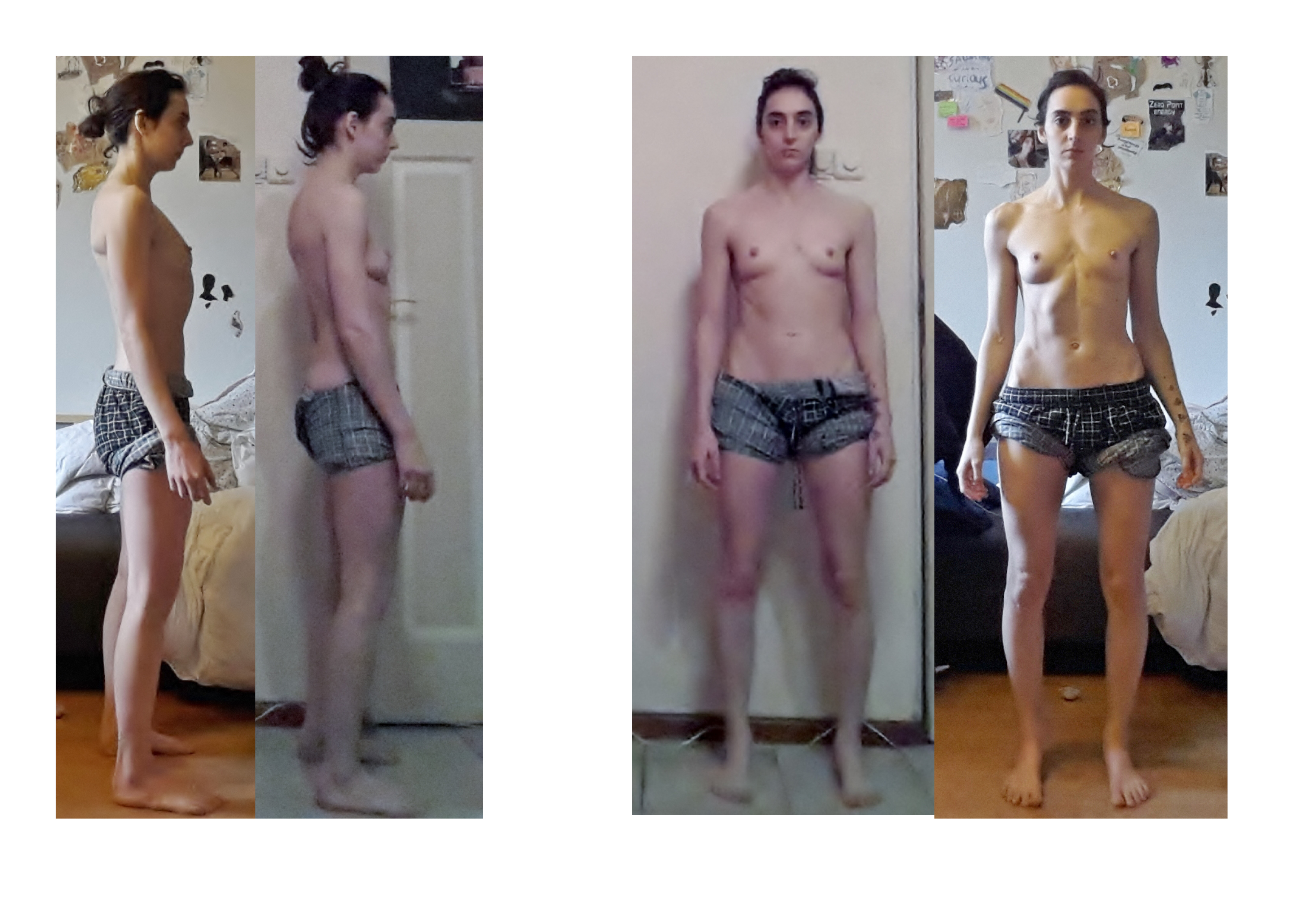
My 30 day summary and before/after pics:

Hopefully I don't have to tell you what's before and what's after

Hopefully I don’t have to tell you what’s before and what’s after

The main outer difference is probably opening of my upper chest, I think my neck and shoulders still need a lot of work.

The inner difference is much less lower back pain, more awareness about posture and the deep realisation (once again) that these changes in habit must come from enjoyment and not just repetitive exercises. I now have a few different variations of exercises (see below) that I play with and include dancing/ kundalini shaking and focus on the “feel good” of the movement. Also doing this thing with friends was awesome and highly recommended. Thanks!

Summary of exercises

Foundation training basic exercise. Helps me more than I could imagine.
use foam roller slowly to open back and relax and some sitting exersizes
The basic exercise we were doing, I was also doing it laying down and sitting instead of standing sometimes
Warming up neck and chin tucks that can be done when sitting http://www.posturecisecrashcourse.com/forward-head-posture?mc_cid=b49d8e1a38&mc_eid=a24c4430d9
Finding movement and alignment in your spine
Hannan somatic stretches I’ve been doing for years on and off
Kundalini shaking
Back mobility exercises I learnt from dancers